How Working Parents Can Still Show Up at School

This is for you if you’ve ever looked at a PTO email desperately looking for last-minute volunteers, or the volunteer sign-up sheet at open house, and thought: I want to help…I just don’t have the time right now. When your schedule is packed with work, commuting, childcare, and neverending sports practices, volunteering often feels like something other parents can do, but not you.
But, here's the thing: making a difference at school isn’t limited to those who have tons of extra time. It’s about what happens when many parents give a little of the time they do have.
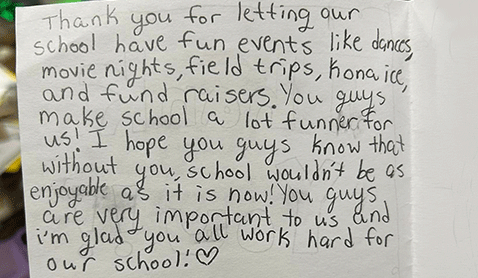
Now, we're not knocking being the first to sign up for "plates and napkins" on the PTO's sign-up sheet (IYKYK)—that kind of steady, behind-the-scenes help keeps things running. But volunteering can also look like showing up for 30 minutes to set up for the book fair, dropping donuts off for a staff appreciation breakfast, or saying yes to one small thing that fits into your real life, like writing encouraging messages on signs for volunteers to hold in the carline during student testing week.
When enough people do that, schools start to feel different...not because a few people did everything, but because a lot of people actually did something.
Volunteering isn’t all-or-nothing
School volunteering isn’t one big commitment. It’s a collection of small moments that can fit into real life—not the other way around.
That’s why many PTOs and PTAs are now building “volunteer menus” as a simple way for parents to choose how and when they help based on their time and skills. The idea isn’t to do everything. It’s to find the slivers of time that actually work for your life:
- Appetizers: quick things you can do from home in 10–30 minutes, like dropping off donuts for a teacher appreciation breakfast, stuffing envelopes, donating supplies, designing a flyer, making fifth grade graduation signs, or helping prep materials for teachers or the PTO
- Sides: a one-hour shift at the book fair, setting up chairs before an event, helping check in families at arrival, donating (or wrapping) gifts for the holiday shop, sticking notes of encouragement on student lockers before state testing week, holding signs during High Five Friday
- Main courses: running a station at field day, helping plan the glow dance, or taking on a leadership role for a school fundraiser
The reality of how PTOs actually work
The reality is that most PTO and PTA groups are a small team that depends on a wide network of parents who each give a little when they can. An hour here. A donation there. A regular meeting to check in. A quick volunteer shift every once in a while when your schedule allows. A few people doing everything isn’t sustainable. It takes many people doing something—small, flexible contributions from lots of families—to power a school community.
Volunteering fits in the spaces real life leaves behind
Working parents—especially those juggling multiple jobs or unpredictable hours—aren’t absent because they don’t care. More often than not, they're navigating busy schedules that don’t always line up with school hours or traditional volunteer roles.
Not everyone can show up the same way…and that’s okay. Small, one-off contributions matter just as much as ongoing roles. Plus, there’s something grounding about knowing that even in a busy season of life, you can still be part of your child’s school community. The look on your child's face, when they see you volunteering at school? Priceless.
So if all you can give is one hour a month, that matters. If you can only step in once or twice a year, that matters. If your support looks like something behind the scenes instead of in the room, that matters too.
You may have more flexibility than you think
79% of PTO leaders say work is the biggest barrier to volunteering—but did you know some states have laws designed to make school involvement easier?
Depending on where you live, you may have more flexibility than you realize.
Several states—and Washington, D.C.—have laws that allow eligible employees to take unpaid, job-protected leave to participate in certain school-related activities. While these laws vary by state, they may cover things like parent-teacher conferences, classroom activities, educational events, and, in some cases, volunteering at your child's school.
These laws don't apply to everyone. Eligibility depends on factors like where you live, the size of your employer, how long you've worked there, and the type of school activity. But if work has always felt like the biggest obstacle to getting involved at your child's school, it's worth finding out whether your state offers this type of leave.
Even if your state doesn't have one of these laws, your employer may offer flexible scheduling, volunteer time off (VTO), or other workplace policies that make it easier to participate.
At 1 Hour for Schools, we believe every family has something to contribute—even if it's just one hour. Whether you can help at a book fair, read to a class, assemble teacher appreciation gift bags, or set up chairs for a school event, that one hour adds up to a big impact for students, teachers, and your school community.
Want to see whether your state has a school-activity leave law? Start by reviewing the National Conference of State Legislatures' overview of state leave laws, then check with your employer's HR department to see whether you're eligible and what policies apply. Remember, these laws vary by state, and employer requirements and qualifying activities differ.